
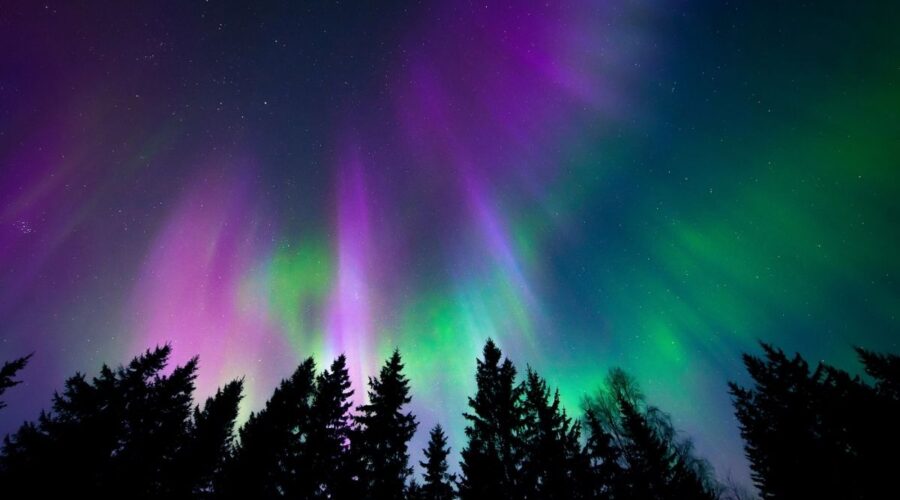
9 U.S. States to See the Northern Lights (Best Odds, NOAA Data)
The Northern Lights are usually a high-latitude spectacle, but during strong solar storms, they can dip down into the United States, lighting up skies across several states. The most reliable place and time to see the aurora borealis is in Alaska throughout the season, or in the northern states of the Lower 48 during October and April.
In this post, we’ll look at nine U.S. states that had the highest chances of seeing the Northern Lights and highlight the best month to visit each for the greatest odds of catching the show.
But instead of relying on anecdotal sightings, this analysis uses NOAA Space Weather Prediction Center (SWPC) historic data from the 2024–2025 aurora season (roughly September through April), based on geomagnetic Kp index data. The higher the Kp, the further south the auroral oval stretches.
So which U.S. States have the highest chance to see the Northern Lights and when?
Aurora Likelihood by State
Not all U.S. states are equal when it comes to aurora viewing.
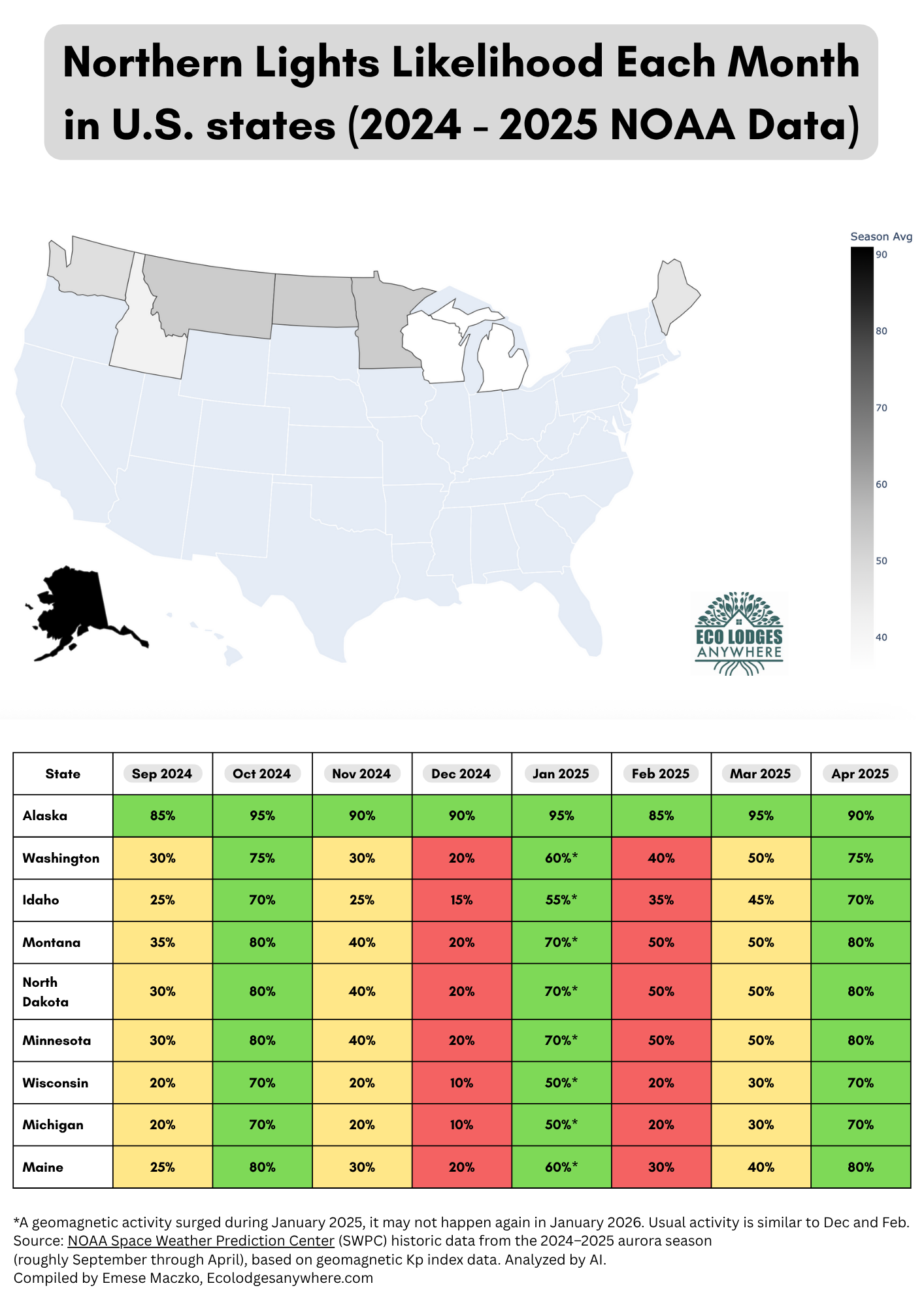
Below is a breakdown of aurora visibility likelihood by month for U.S. states that had at least one month where chances exceeded 50%. It means it is more likely than not to catch an aurora if you were there during that month.
This assessment is based on historic NOAA SWPC geomagnetic data, analyzed by AI. Essentially, it is about how often the Kp index peaked high enough to make auroras visible in those states between September 2024 and April 2025.
- High means the chances of having an aurora is likely above 50%.
- Moderate means aurora is possible but occasional with roughly 20–50%.
- Low means the chances of aurora is unlikely with less then 20%.
A quick note: Only states that at least once hit “High” in a given month are listed.
Best Place and Time To See the Northern Lights in 2025
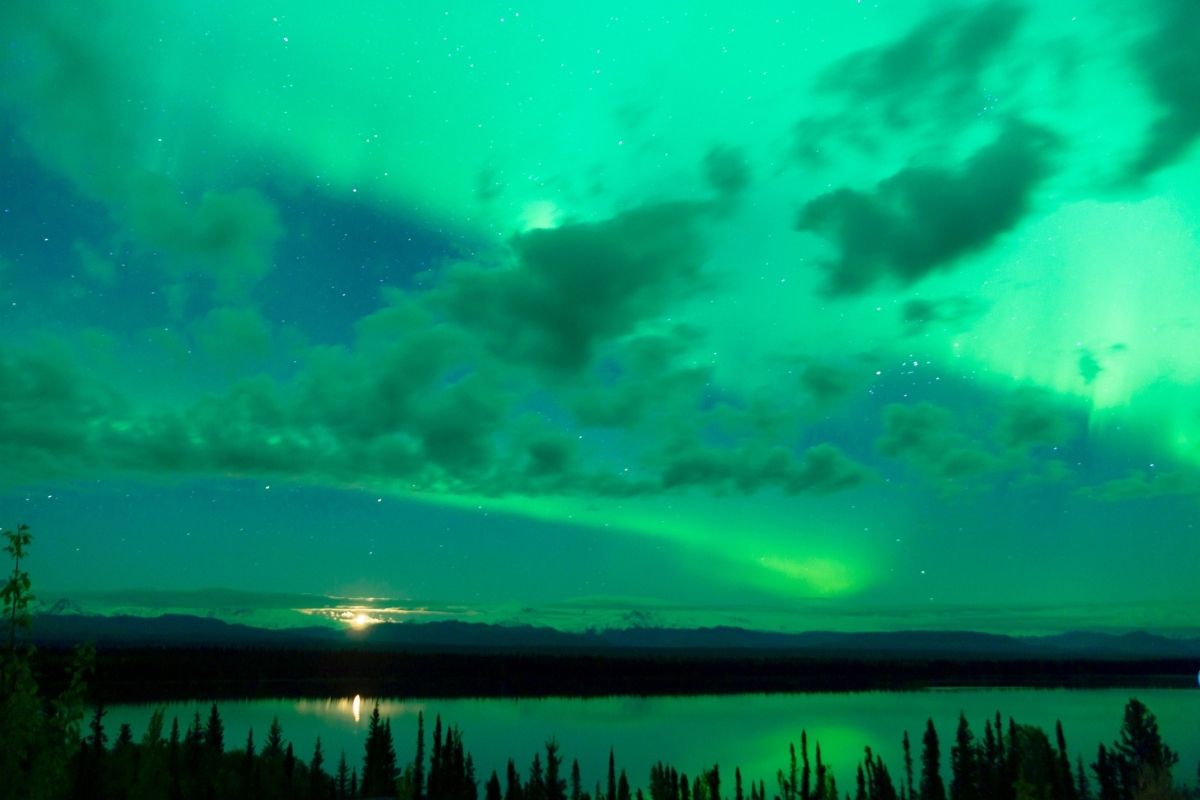
Alaska stands apart thanks to its aurora-friendly geomagnetic latitude and long winter nights. In 2025, Alaska will again have high odds all season.
The northern tier of the Lower 48 benefited from the large geomagnetic storms in Oct 2024, Jan 2025, and Apr 2025 that hit around the fall and spring equinoxes. It means that October and April will likely offer the best chances to see the aurora this year as well.
Please note that during quieter winter months, unless a smaller storm passes through, the likelihood of seeing the Northern Lights in the Lower 48 is very low.
October 2024 was exceptional with a series of severe storms that made auroras visible in all these states and even well beyond. Compared to that December 2024 was very quiet, so even in Washington or Michigan the odds of seeing auroras were slim to none that month.
Since light pollution affects visibility, check out Go Astronomy’s comprehensive list of dark sky parks across the U.S. The sites are categorized using the Bortle Scale, which ranks night-sky brightness from 1 (the darkest, best for stargazing) to 9 (brightest inner-city skies). For the best chance to see the Northern Lights, choose destinations rated Bortle 1 or Bortle 2.
Alaska (91%)

The undisputed aurora capital of the U.S., Alaska enjoyed nearly continuous Northern Lights activity from September through April. The lights were visible most clear nights under dark skies. The best months are October, January and March, when visibility will likely peak again at 95%.
The best places in Alaska are:
- Denali National Park, Alaska’s most famous national park, has vast, light-free wilderness and frequent aurora displays. Visitors often see the Northern Lights from areas near the park entrance or Healy on clear nights.
- Wood-Tikchik State Park is the largest state park in the U.S., located in western Alaska. Though remote, it is a dream destination for serious stargazers and aurora photographers.
- Chilkat Bald Eagle Preserve is near Haines, an area renowned for its eagle population and equally spectacular dark skies. It is often the top choice for travelers wanting both wildlife and night-sky experiences due to its easy access via Haines regional airport.
WHERE TO STAY – Explore sustainable stays or discover the best eco-lodges in Alaska.
Montana (53%)
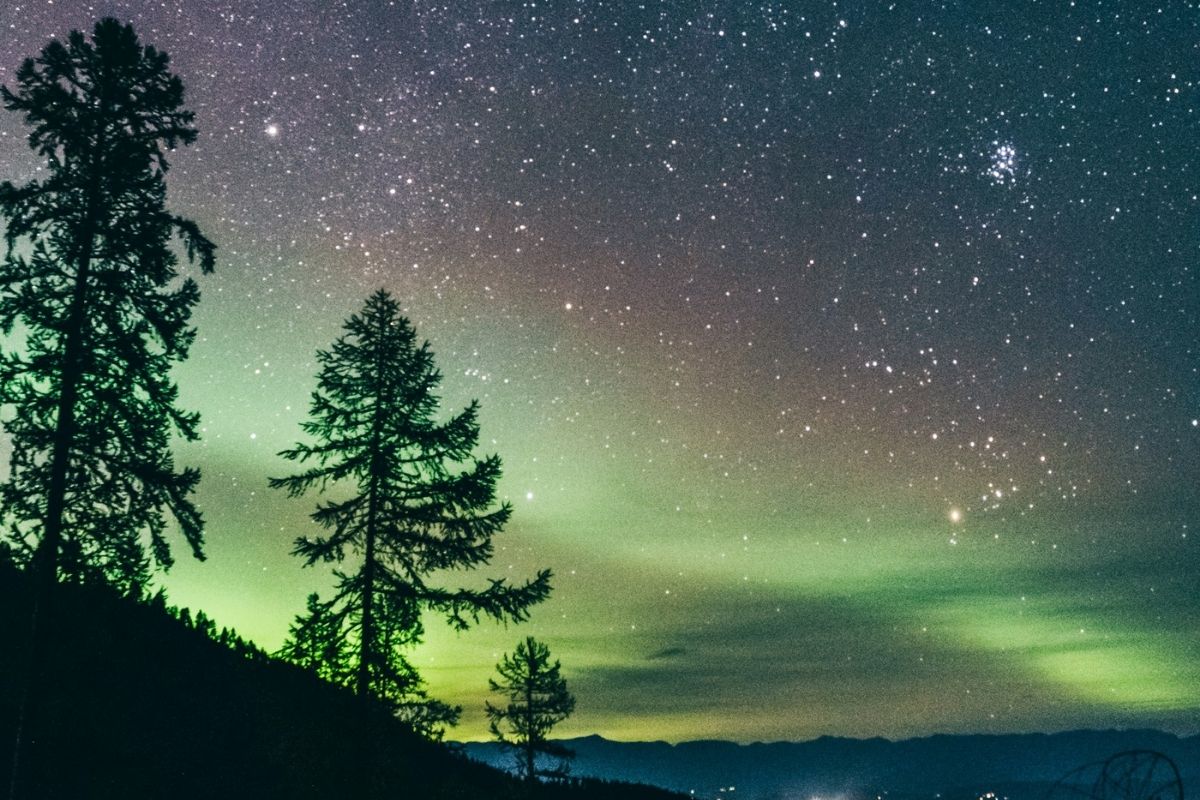
With wide-open skies and high latitude, Montana will likely offer consistent aurora chances during strong solar activity. The best months are October and April, when visibility will likely peak again at 80%.
The best places in Montana are:
- Glacier National Park was the first IDA International Dark Sky Parks in Montana, together with its neighbor across the border, Waterton Lakes National Park in Alberta, which is one of the most visited national parks in Canada.
- Flathead National Forest is stretching across northwestern Montana with a vast forested area. The combination of mountain peaks, alpine lakes, and minimal light pollution makes it ideal for stargazing and occasional aurora sightings beyond Glacier National Park.
- Hell Creek State Park lies along the shores of Fort Peck Lake in eastern Montana. This area is open prairies and wide horizons create perfect conditions to catch the Northern Lights and the Milky Way.
WHERE TO STAY – Discover the best eco-lodges in Montana.
North Dakota (53%)
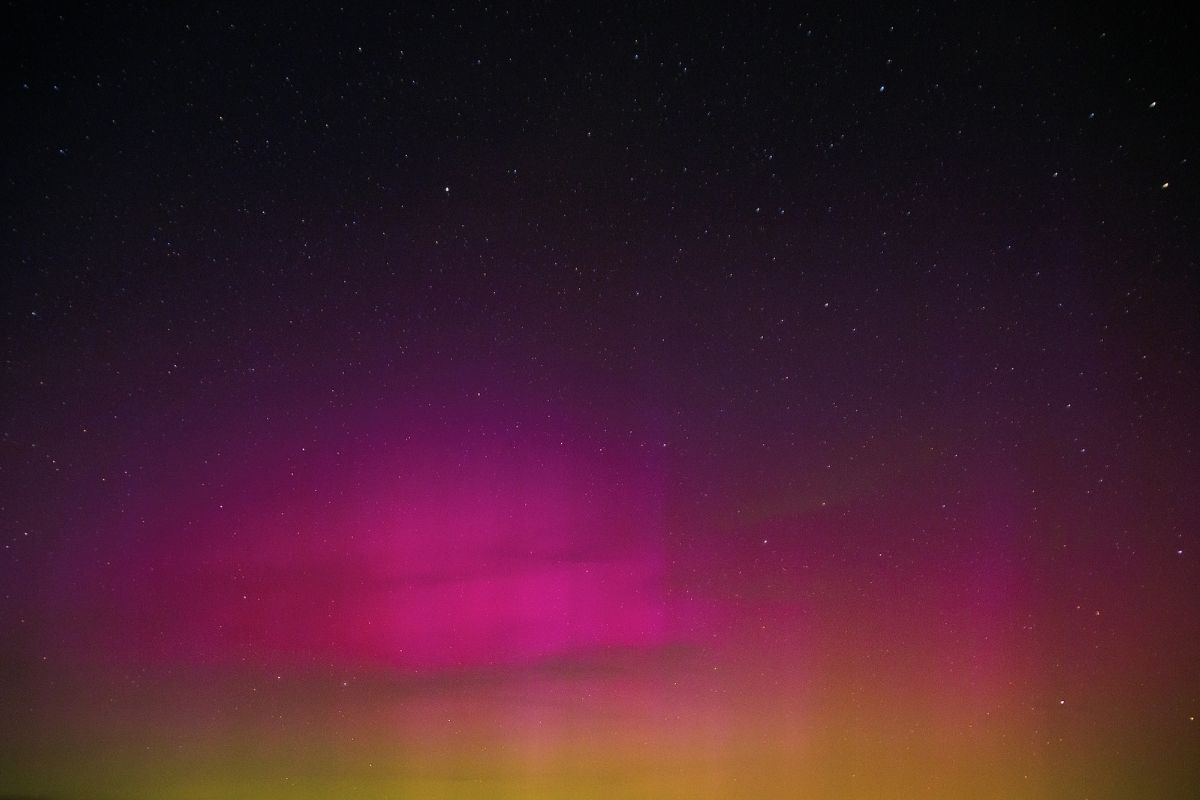
Flat horizons and dark rural areas made North Dakota one of the best Lower 48 states for aurora chasing. The best months are October and April, when visibility will likely peak again at 80%.
The best place in North Dakota with Bortle 2 is Beaver Lake State Park. It is a peaceful park by a quiet glacial lake that offers wide-open night skies. Since it is far from major cities, its low light pollution allows clear views of the Milky Way and the Northern Lights reflecting over the water.
Minnesota (53%)
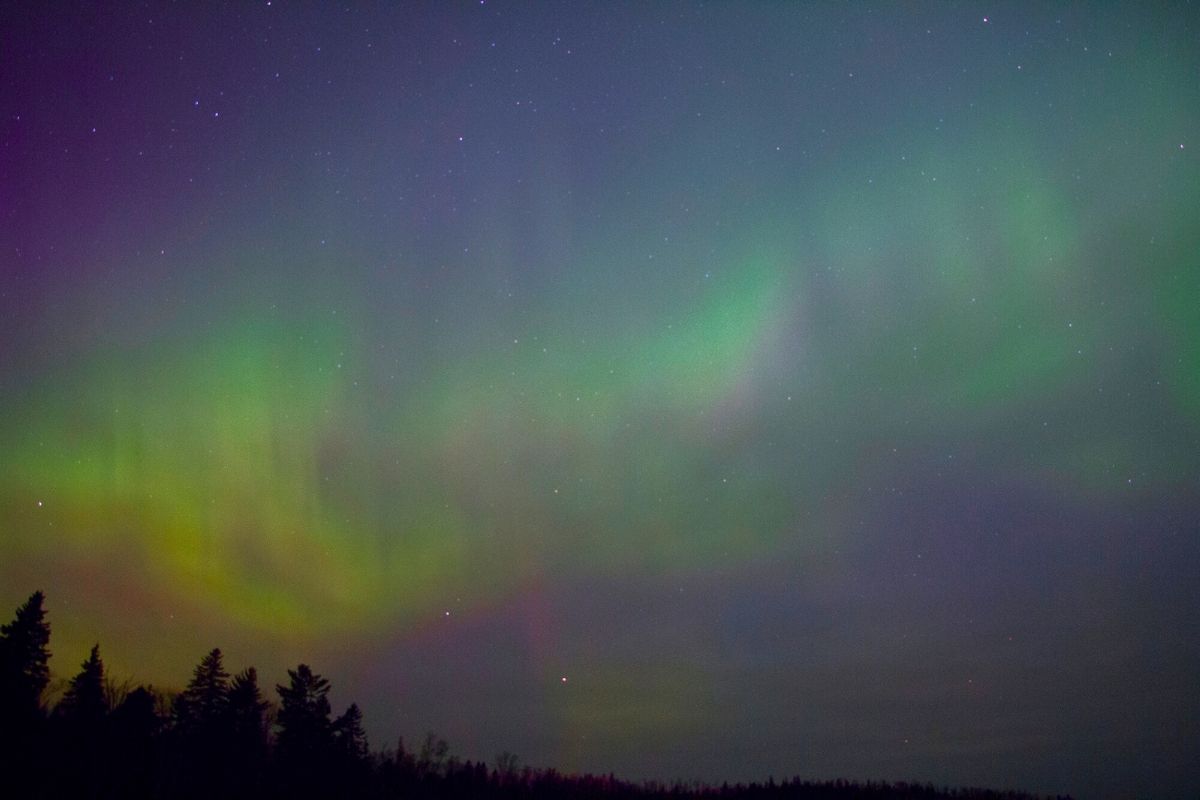
Northern Minnesota, especially near Lake of the Woods, saw excellent shows during active months. The best months are October and April, when visibility will likely peak again at 80%.
The best places in Minnesota are:
- Voyageurs National Park is one of the least visited national parks in the U.S and Minnesota’s only water-based national park. It is also an International Dark Sky Park since 2020 to stargaze and witness the Northern Lights reflected in the waters.
- Boundary Waters Canoe Area Wilderness is another International Dark Sky Park, spanning more than a million acres in northern Minnesota. Thanks to its pristine wilderness is one of the best places in the continental U.S. for stargazing and aurora viewing. With no artificial light and thousands of interconnected lakes, paddlers can watch the Northern Lights dance across mirrored waters in complete silence.
- Judge C. R. Magney State Park is a small but dramatic park with waterfalls, dense forest, and dark night skies. It is a Bortle 1 location near Lake Superior offering a peaceful spot to catch the aurora.
Washington (48%)

Washington’s skies lit up dramatically during major storms, particularly when Kp levels spiked in fall and spring. The best months are October and April, when visibility will likely peak again at 75%.
Washington has no International Dark Sky Park, so your best bet is to visit one of its national parks.
- Mount Rainier National Park offers greater chances thanks to its high-altitude locations, just a few hours from Seattle.
- North Cascades National Park, also known as the “American Alps,” has rugged wilderness with dramatic peaks, alpine lakes, and some of the darkest skies in Washington. Remote viewpoints like Diablo Lake Overlook provide spectacular opportunities to catch the Northern Lights display.
- In Olympic National Park visitors can experience near-total darkness (Bortle 2) and with a bit of luck, the aurora.
Maine (46%)
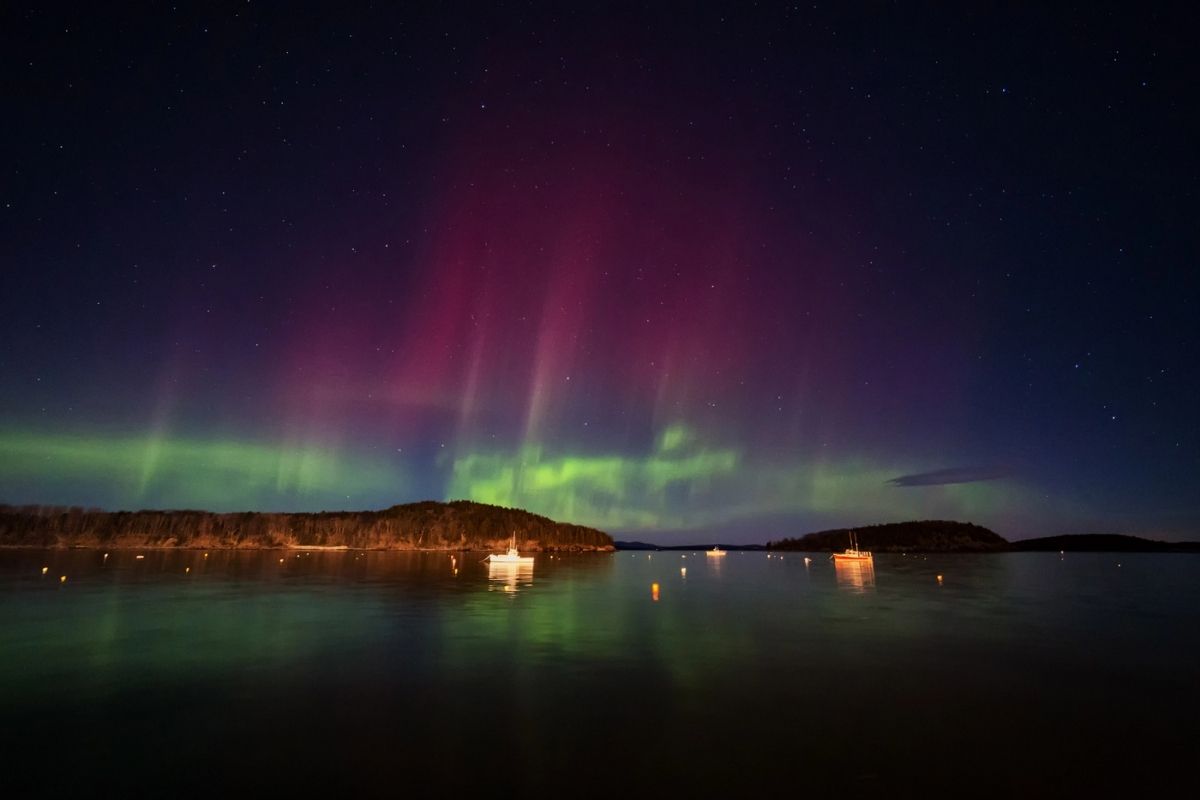
As the northeasternmost state, Maine saw regular auroral arcs throughout the season, especially along its northern border. The best months are October and April, when visibility will likely peak again at 80%.
Maine has two International Dark Sky Parks and without a doubt these are the best places to catch the aurora in the state.
- AMC Maine Woods International Dark Sky Park is near Greenville. This vast conservation area, managed by the Appalachian Mountain Club, is designated an International Dark Sky Park since 2023. Thanks to its remote forests, this is one of the best places in New England to witness the Milky Way and the Northern Lights.
- Katahdin Woods and Waters National Monument is near Patten in northern Maine. It is an International Dark Sky since 2020 due to its pristine night skies and low light pollution.
Idaho (42%)
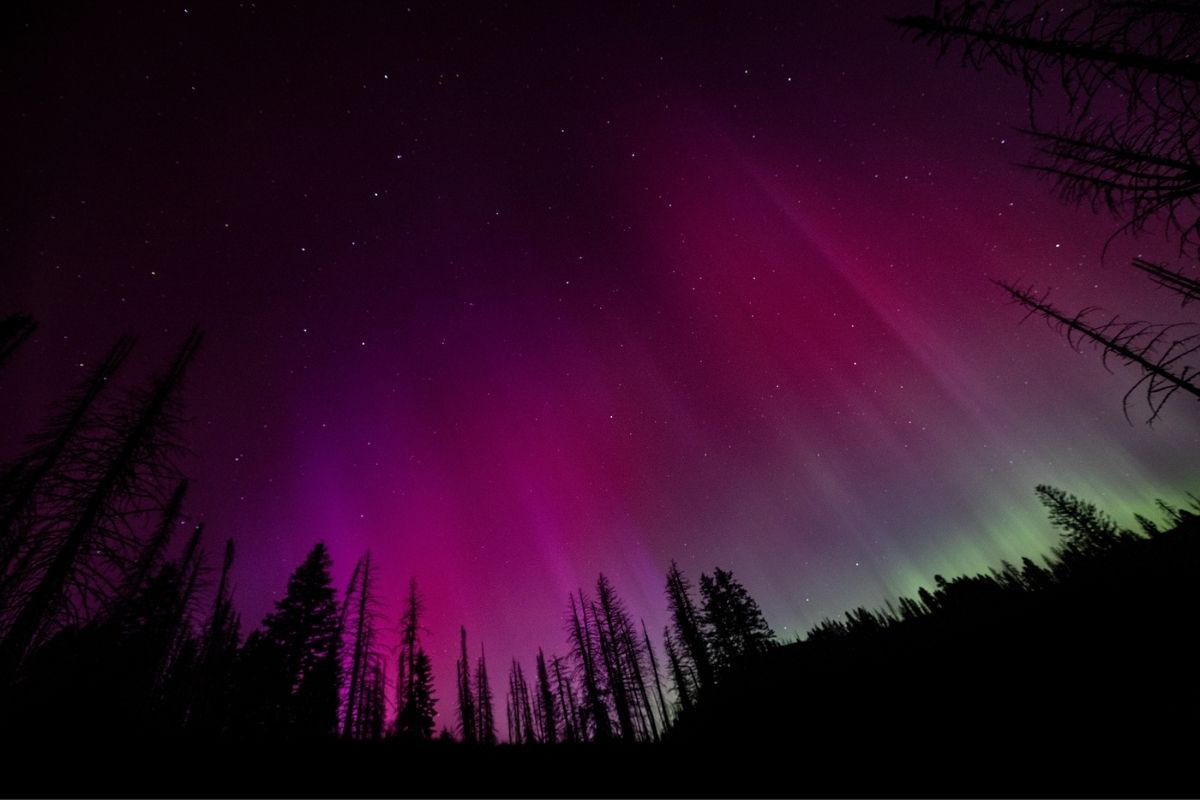
Typically just south of the auroral oval, Idaho saw rare but strong aurora events during the season’s largest storms. The best months are October and April, when visibility will likely peak again at 70%.
Idaho has multiple International Dark Sky Parks, but not all of them are Bortle 1.
- Central Idaho Dark Sky Reserve is a large, over 900,000-acre International Dark Sky Reserve since 2017. It includes portions of the Nez Perce, Payette, and Salmon-Challis National Forests, all Bortle 1 zones with the darkest and clearest skies in the country. Its remote location makes it a premier destination for stargazing, astrophotography, and occasional aurora viewing.
- Craters of the Moon National Monument & Preserve feels like an otherworldly landscape of ancient lava flows and cinder cones. They provide an equally surreal backdrop for night-sky observation as one of Idaho’s first International Dark Sky Park.
- City of Rocks National Reserve with its dramatic granite spires and pioneer history is another location with clear night sky. It is yet another International Dark Sky Park, and a favorite among both climbers and stargazers.
Wisconsin (36%)
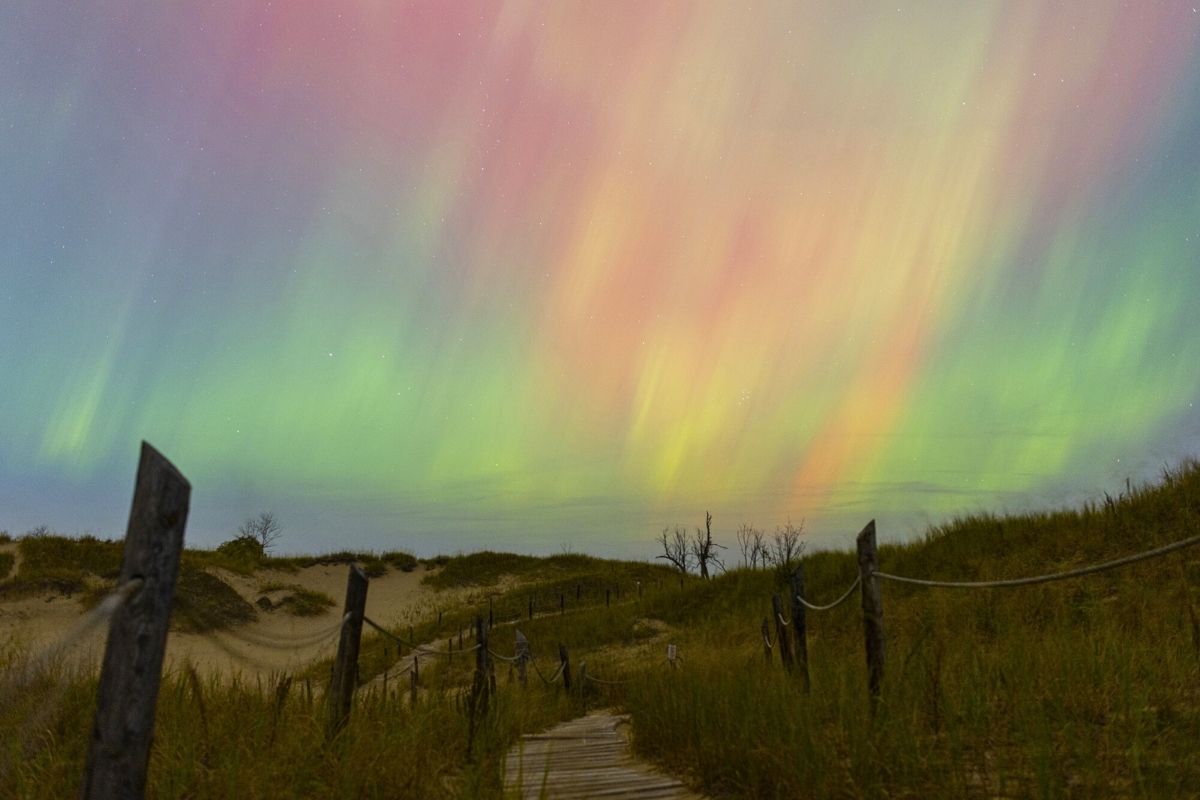
While southern parts of the state rarely see the aurora, northern Wisconsin had several clear nights with vivid displays. The best months are October and April, when visibility will likely peak again at 70%.
The best places to see the Northern Lights in Wisconsin are:
- Newport State Park is on the tip of Wisconsin’s Door Peninsula. This secluded shoreline park became the state’s first International Dark Sky Park. With unobstructed views of Lake Michigan and minimal light pollution, it’s an excellent spot for stargazing and catching the Northern Lights.
- Big Bay State Park is on Madeline Island in Lake Superior. Big Bay is a combination of sandy beaches, boreal forest, and dark skies with Bortle 2 ranking.
- Chequamegon–Nicolet National Forest is a vast, over 1.5 million-acre forest across northern Wisconsin. This forest provides expansive dark-sky areas perfect for viewing the Milky Way and glimpsing at the aurora glowing above the pine trees.
Michigan (36%)
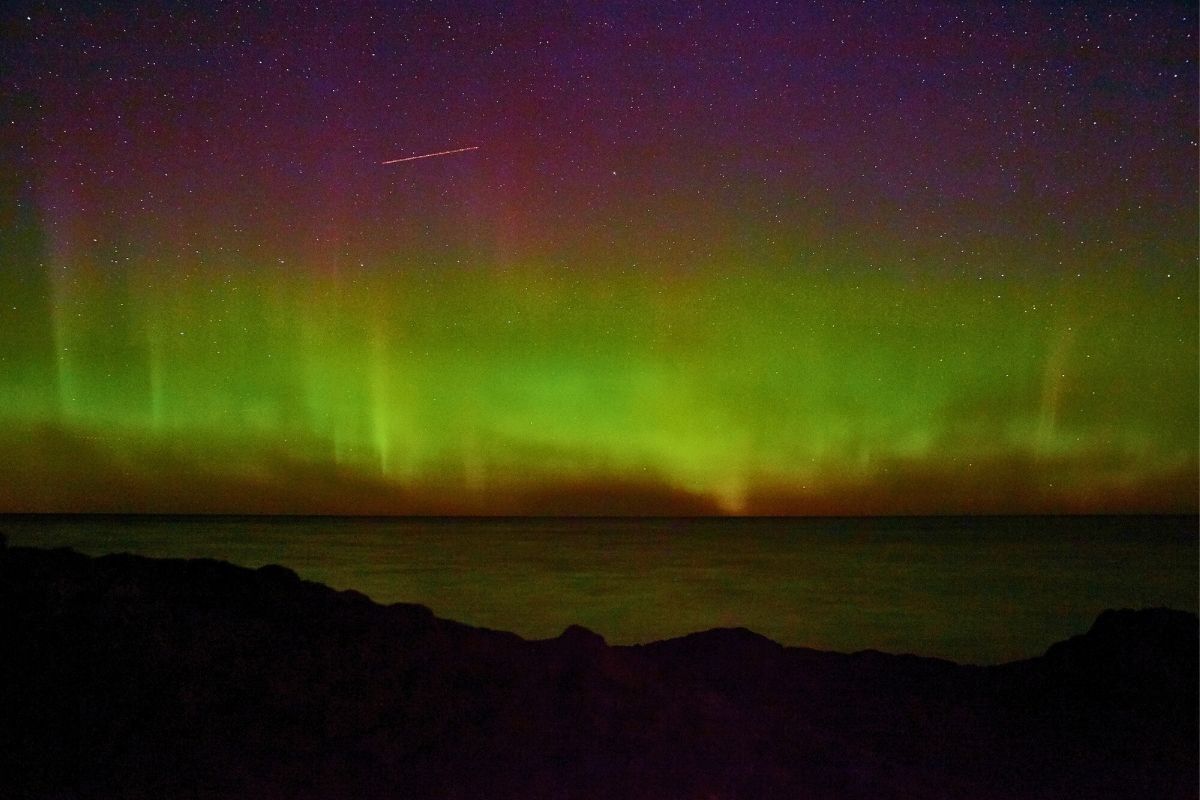
While Northern Michigan offers better chances, the state overall has relatively low visibility compared to more northern regions like Minnesota or North Dakota. The best months are October and April, when visibility will likely peak again at 70%.
The best places to catch the aurora in Michigan are:
- Muskallonge Lake State Park lies between Lake Superior and Muskallonge Lake in Michigan’s Upper Peninsula. Despite it is not a designated dark sky park, its location offers clear skies fwith Bortle 1 ranking. Its remote location and dual lake views make it a stunning setting to watch the Milky Way or catch the Northern Lights.
- Headlands International Dark Sky Park is near Mackinaw City. It is officially designated International Dark Sky Park since 2011, offering easy access and year-round astronomy programs for visitors.
- Keweenaw Dark Sky Park is the youngest International Dark Sky Park in Michigan, designated in 2022. With its rugged shoreline, historic lighthouses, and virtually no light pollution, it’s one of the best places in the Midwest to experience true night-sky brilliance and vivid Northern Lights displays.
Tips for Aurora-Seeking Travelers
Pick the Right Month
Auroral activity follows the 11-year solar cycle, peaking around solar maximum when the Sun is most active. We are nearing a solar max now, so auroras are more frequent and vibrant this year.
Historically, the auroras tend to be more intense around the fall and spring equinoxes than around winter or summer solstice (known as the Russell-McPherron effect).
In other words, September/October and March/April have statistically higher aurora activity than mid-winter, which is a great news for autumn and spring travelers.
Choose Your Location Wisely
The farther north, the better your baseline odds. Alaska should be your top choice but if it is too remote for you to travel there, head to the northernmost states of Lower 48, such northern Minnesota, North Dakota, and Montana.
Search for high grounds, lakeshores, remote areas, wilderness lodges that can provide a clear view.
Plan for Late Nights (and Cold)
Aurora shows often peak around local midnight or in the hours after. Be prepared to stay up late.
Unless you stay in a glass cabin in the middle of nowhere, you have to be outside for a long time. Dress in warm layers appropriate for winter conditions. It is a good idea to have insulated boots, thermal clothing, and perhaps a warm drink in a thermos.
Give Yourself a Few Nights
Nothing is guaranteed on a single night. If possible, plan a multi-night stay in your chosen location. Even three or four nights can dramatically increase the probability that one of them will have both clear skies and aurora activity.
Get Your Cameras Ready
Even if you are not a photographer, having a smartphone with camera on Night mode or a DSLR with long exposure is important. Since cameras often detect green/purple colors before the human eye does, it helps you pick up faint auroras.
More articles about nature



Emese Maczko is a travel blogger behind Eco Lodges Anywhere. Having explored several destinations around Europe, the US, Indonesia, and Australia, and resided in Germany, the United Kingdom, and Luxembourg, Emese possesses a keen understanding of diverse cultures and an appreciation for the beauty of each destination she visits. She advocates for sustainable travel and ecotourism.